COMPARISONS
OpenRouter Alternatives Compared on Price and Privacy (2026)
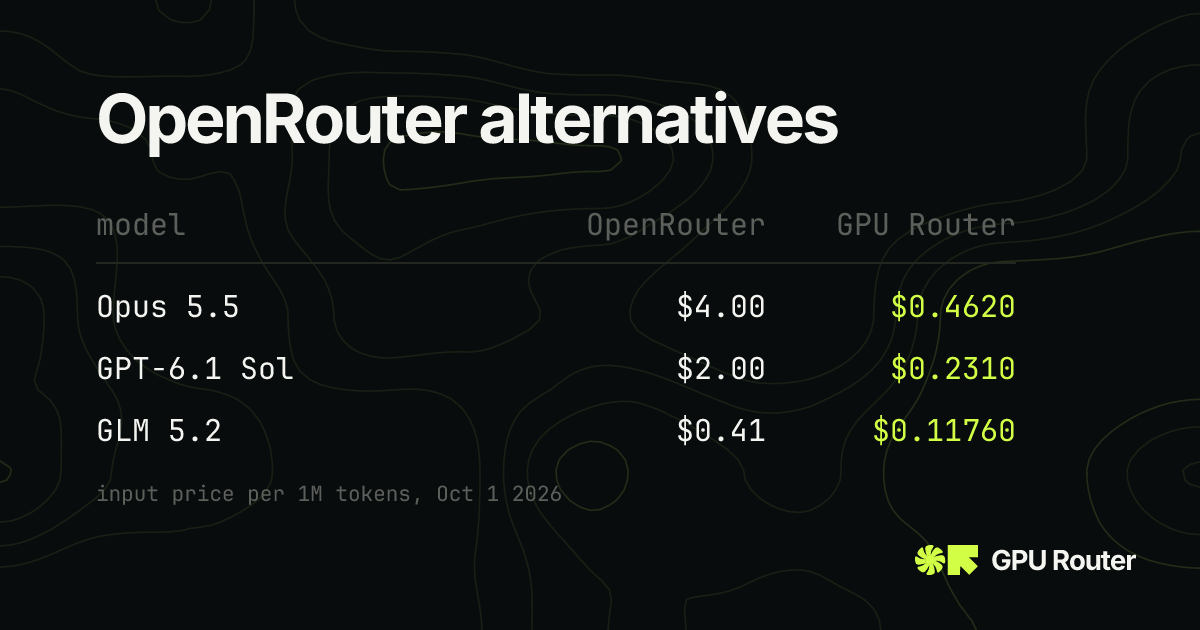
OpenRouter alternatives range from hosted routers that sell you tokens to gateways you run in front of your own provider keys. Which one fits depends on why you're leaving. If it's price, the field narrows fast, because most gateways pass the provider's list price through, sometimes with a fee on top.
If price is the reason, we'd point you to GPU Router, which is our product. It's an OpenAI-compatible API that sends each request to the lowest-cost eligible route for the exact model you name. On October 1, 2026, our quotes for Claude Opus 5.5, Claude Sonnet 5, GPT-6.1 Sol, Gemini 3.8 Flash and Grok 4.7 were all 88.5% below their direct list prices, the same prices OpenRouter bills. Quotes move with supply, so that figure changes from day to day.
We know because at 18:10 UTC that day we pulled our live catalog and OpenRouter's public models API 14 seconds apart and matched the 134 model IDs that appear in both. On most of them our quote was lower; on seven, OpenRouter's was, and the table below shows both.
What is the best OpenRouter alternative?
For lower prices on the same model IDs, choose GPU Router: in our snapshot its quotes undercut OpenRouter's listed prices on 127 of the 134 IDs both catalogs carry. LiteLLM suits teams hosting their own proxy, and Vercel's or Cloudflare's gateway fits apps already on those platforms. Together AI and DeepInfra sell open models at their own rates.
The quick verdict, with each vendor's terms as published when we checked:
| Option | What it is | What you pay for tokens | Privacy default or control | Pick it for |
|---|---|---|---|---|
| GPU Router | Hosted OpenAI-compatible API | Cheapest eligible route per model; quotes include our routing fee; savings capped at 95% | zdr: true per request, optional redaction | Lower prices on the same model IDs |
| OpenRouter (baseline) | Hosted router | Provider list price, no markup on inference | No prompt storage unless you opt in; ZDR setting or per-request flag | Breadth and free variants |
| LiteLLM | Open-source proxy you run | Your own provider contracts; the software is free | Runs on your infrastructure | Full control |
| Vercel AI Gateway | Hosted gateway | Provider list price, no markup | ZDR routing on Pro and Enterprise | Apps already on Vercel |
| Cloudflare AI Gateway | Gateway in front of providers | Your provider's rates, no token markup | Logs on by default and can include prompts; can be turned off | Teams already on Cloudflare |
| Portkey (Prisma AIRS AI Gateway) | Enterprise gateway with an MIT core | Your own provider keys; plans priced by logs | Self-host the open-source gateway | Request logs and fallbacks |
| Requesty | Hosted router | Provider cost plus 5%; 0% with your own keys | Logs on by default for 30 days; EU endpoint | EU hosting |
| Together AI | Open-model inference host | Its own rates | Stores prompts by default; ZDR toggle | Open models, plus training |
| DeepInfra | Open-model inference host | Its own rates | Doesn't store inputs on disk | Open models, inputs kept off disk |
Is there a cheaper alternative to OpenRouter?
For most models we checked, yes. OpenRouter passes through each provider's list price, so a cheaper option has to buy the same model for less. In our snapshot, GPU Router's quote for 1M input plus 1M output tokens was lower than OpenRouter's listed price on 127 of the 134 model IDs both catalogs share.
Prices retrieved October 1, 2026: GPU Router catalog at 18:10:11 UTC, OpenRouter models API at 18:10:25 UTC. USD per 1M tokens, input / output, as each catalog lists them. Prices change.
| Model | OpenRouter listed | GPU Router quote | 1M in + 1M out (OpenRouter vs GPU Router) |
|---|---|---|---|
| Claude Opus 5.5 | $4 / $20 | $0.4620 / $2.310 | $24.00 vs $2.77 |
| Claude Sonnet 5 | $2 / $10 | $0.2310 / $1.155 | $12.00 vs $1.39 |
| GPT-6.1 Sol | $2 / $10 | $0.2310 / $1.155 | $12.00 vs $1.39 |
| Gemini 3.8 Flash | $0.75 / $3.75 | $0.08663 / $0.43313 | $4.50 vs $0.52 |
| Grok 4.7 | $2 / $6 | $0.2310 / $0.6930 | $8.00 vs $0.92 |
| GLM 5.2 | $0.41 / $3.99 | $0.11760 / $0.36960 | $4.40 vs $0.49 |
| DeepSeek V4 Pro | $0.2088 / $0.4176 | $0.024117 / $0.048233 | $0.63 vs $0.07 |
| Kimi K3 | $0.6635 / $10 | $0.136578 / $1.995 | $10.66 vs $2.13 |
| gpt-oss-120b | $0.037 / $0.17 | $0.044370 / $0.221846 | $0.21 vs $0.27 |
| Qwen3.6 35B A3B | $0.15 / $1.00 | $0.25657 / $1.536320 | $1.15 vs $1.79 |
OpenRouter's column is the per-token price its models API listed for each ID, which its docs define as the cost per input and output token. For the five closed models at the top, it matched the direct list price in our catalog exactly. That fits OpenRouter's own pricing page: inference "is billed at the provider's list price on every plan."
Our column is the quote from the cheapest eligible route, and it includes our routing fee. Using (1 − our price ÷ list price) × 100 on 1M input plus 1M output tokens, the five closed models and DeepSeek V4 Pro were 88.5% below list. GLM 5.2 was 91.6% below its $1.40 / $4.40 direct list price in our catalog, a list price OpenRouter undercuts at $0.41 / $3.99.
A quote isn't a bill, though. Your final charge depends on the route that serves the request and the tokens you actually use.
The last two rows go the other way. OpenRouter listed gpt-oss-120b and Qwen3.6 35B A3B below our quotes, and across the full overlap we found seven such IDs, including gpt-oss-20b and Qwen3.8 27B. If most of your traffic goes to those models, OpenRouter may already be the cheaper call.
Discounts also vary a lot by model. In the same snapshot, Claude Haiku 4.5 was quoted 28.6% below its direct list price and Trinity Large Thinking only 5.1% below.
Open-model hosts set their own rates, too. For Kimi K3, Together AI listed $3.00 / $15.00 and DeepInfra $2.85 / $14.25 on their pricing pages that day, against OpenRouter's $0.6635 / $10 and our $0.136578 / $1.995.
Why are our quotes lower at all? Teams reserve capacity and prepay for usage they don't always need, and suppliers can sell that spare capacity for less. How much exists varies by model and changes over time, and so do our quotes. Claude Sonnet 5's input quote was $0.5460 per million tokens when we published our Claude API pricing comparison on September 30, and $0.2310 a day later.
Why do teams look for OpenRouter alternatives?
Price comes first: a pass-through router bills what the provider charges, so it can't go below that. The rest are about where your data goes and what you control. None of them makes OpenRouter a weak product: it's still cheaper on a few models, and it lists about twice as many paid models as we route.
OpenRouter does a lot well. Its homepage claims "500+ active models on 80+ providers," its :free variants let you try models without paying, and it supports OpenAI Chat Completions, OpenAI's Responses API and Anthropic's Messages API. Where it runs out:
- Provider data collection is allowed by default. OpenRouter doesn't store your prompts unless you opt in, but its
data_collectionprovider filter defaults toallow, which its docs describe as allowing "providers which store user data non-transiently and may train on it." You can set it todenyor require ZDR endpoints per request, and enforce ZDR account-wide. - Someone else runs it. Some teams need keys and traffic inside their own network, which rules out any hosted router.
- Governance features. LiteLLM is built around virtual keys and budgets, Portkey around recorded logs and fallbacks.
The 8 OpenRouter alternatives
1. GPU Router: lower quotes on the same model IDs
We built GPU Router to find a cheaper route to the same model when one exists. Each request goes to the least expensive eligible route for the exact model ID you send.
If the discounted routes fail, the Reference provider is the last fallback for the same model, at list price. Failures before the response starts can retry, but a response that's already streaming isn't restarted. Routing explains how we order routes, and our LLM router explainer covers how that differs from routers that pick the model for you.
You pay per request from prepaid credit. Catalog quotes, including the ones in the table, already include our routing fee, and savings are capped at 95%. New accounts get $1 in free prepaid credits, with no payment required.
The model catalog lists live route prices with filters, comparison and CSV export, and every model page adds price history and a workload cost calculator.
If a discounted quote is the only reason you'd send a request, turn on minimum quoted savings in Settings. When no eligible quote meets your minimum after fees, the paid request stops with HTTP 503 minimum_savings_not_met instead of going out at full price. It's off by default, and because it filters quoted rates, it can't guarantee your final bill.
Now the limits. We offer OpenAI Chat Completions only, with no Responses API and no Anthropic Messages API, so Codex and Claude Code won't work by pointing their base URL at us. Our catalog is also smaller: 210 models had a priced, eligible route in our snapshot, against 437 paid model IDs in OpenRouter's default listing.
2. LiteLLM: the proxy you host yourself
Is LiteLLM similar to OpenRouter? Only on the surface. Both give you one OpenAI-compatible endpoint for many providers, but LiteLLM is software you run rather than a service you buy tokens from. The project's README calls it an "Open Source AI Gateway for 100+ LLMs," and the code is MIT-licensed outside its enterprise directory.
You bring your own provider keys and pay each provider directly, so token prices are whatever your contracts say. The open-source gateway costs nothing, and the free tier on LiteLLM's pricing page includes virtual keys, spend tracking, budgets, rate limits and fallbacks. Enterprise pricing isn't published; the page says it's "never per token." Our LiteLLM vs OpenRouter comparison goes head to head on cost, routing and privacy, with a proxy config that puts a hosted router behind LiteLLM.
3. Vercel AI Gateway: list price, no platform fee
Vercel's gateway bills the way OpenRouter does, at provider list prices, but says it adds no platform fee. Its pricing docs say: "AI Gateway charges no markup and no platform fee on tokens. You pay the provider's list price on a pay-as-you-go basis." Payment processing fees may still apply.
The free tier includes $5 of credit a month on a subset of models, and bring-your-own-key traffic carries no fee on the paid tier.
The API is OpenAI-compatible at https://ai-gateway.vercel.sh/v1, and its docs also cover the OpenAI Responses API (in beta) and the Anthropic Messages API. Provider ZDR routing is available on Pro and Enterprise plans; by default, the gateway doesn't route on providers' retention policies.
4. Cloudflare AI Gateway: caching and controls in front of your providers
Cloudflare's AI Gateway sits in front of the providers you call and adds analytics, caching and rate limiting, which Cloudflare offers for free. You can send your own provider keys, store them with Cloudflare, or use Unified Billing, where you buy credits from Cloudflare and call providers without keys of your own. Under Unified Billing, provider prices pass through with no markup and a 5% fee applies to the credits you buy.
Logging is on by default for each gateway, and Cloudflare notes that a log can include the prompt and response. You can turn collection off for a gateway, or skip it for a single request. Cloudflare also offers an OpenAI-compatible chat completions endpoint. It doesn't discount tokens either way: with your own keys you pay your provider's rates, and Unified Billing passes them through.
5. Portkey: now the Prisma AIRS AI Gateway
Portkey is a gateway for teams that want logs, retries, fallbacks and load balancing across providers. Palo Alto Networks closed its acquisition of Portkey on May 29, 2026, and portkey.ai now leads with "Portkey is now PRISMA AIRS AI Gateway." The core gateway is open source under the MIT license, so you can host it yourself.
You connect your own provider keys. Portkey's pricing page still lists a free Developer tier with 10,000 recorded logs a month, described as not suitable for production, and a $49-a-month Production plan with 100,000 recorded logs. Enterprise pricing is custom. With the product now sold under a new name, confirm the current plans before you budget.
6. Requesty: a hosted router with an EU endpoint
Requesty is the closest hosted match to OpenRouter. Its homepage advertises 600+ models behind one OpenAI-compatible endpoint, with routing, caching and governance included. Its pricing page is direct about cost: you pay what your application spends "plus 5%." Its homepage puts bring-your-own-key traffic at 0%.
The draw is EU hosting. Requesty runs a Frankfurt endpoint at router.eu.requesty.ai. Its security page says logging is "on by default, encrypted, in the EU, for 30 days." You can switch logging off per key, and organization-wide zero data retention is enabled on written request.
7. Together AI: open models, plus training
Together AI isn't a router. It serves open models behind an OpenAI-compatible API at https://api.together.ai/v1, and it offers training as well as inference. Prices are its own: its pricing page listed GLM-5.3 at $1.40 input and $4.40 output per million tokens when we checked.
Check the privacy settings before you send anything sensitive. Together's privacy docs say that by default it "stores the prompts you send and the responses models return, and may use them for product improvements." Zero data retention is an organization setting, and it's off until you turn it on.
8. DeepInfra: inputs kept in memory, not on disk
DeepInfra is another open-model host, with an OpenAI-compatible endpoint at https://api.deepinfra.com/v1/openai. Its pricing page listed DeepSeek-V4-Pro at $1.30 input and $2.60 output per million tokens when we checked.
The default data policy is stricter than Together's. DeepInfra says it doesn't store the data you submit to its APIs on disk and holds it in memory only during inference. Nor does it train on that data, except on Google and Anthropic models, where those companies' training policies apply. Bulk inference jobs may be stored longer.
Which OpenRouter alternative is best for privacy?
If prompts must never reach a third-party gateway, host LiteLLM or Portkey's open-source gateway yourself. To stay on a hosted service but send traffic only to zero-data-retention routes, GPU Router's zdr: true, OpenRouter's ZDR setting and Vercel's ZDR option on Pro and Enterprise plans filter routes per request, and Requesty lets you pin traffic to endpoints that retain nothing.
On GPU Router, add "zdr": true to every Chat Completions request (in Python, extra_body={"zdr": True}). The model ID stays the same. If no ZDR route can serve the request, you get HTTP 503 privacy_route_unavailable, never a silent fallback to standard handling.
Retention on a ZDR route is governed by the serving provider's ZDR policy, and usage metadata such as tokens, cost and timing remains. ZDR routes also have their own quotes. In our snapshot, GPT-6.1 Sol was $1.890 input and $9.450 output with ZDR, against $0.2310 and $1.155 for standard requests and the $2 / $10 list price. The ZDR docs and the list of ZDR models cover the details.
Optional redaction can replace or reject detected emails, formatted phone numbers, US Social Security numbers, valid payment cards, some API-key formats and up to 100 custom terms before a request is dispatched. It's pattern matching, not anonymization, and it doesn't turn on ZDR.
Ordinary receipts store model, provider, tokens, cost, outcome and timing, not ordinary prompt and response bodies. Privacy and call data explains both controls.
How do you switch from OpenRouter to GPU Router?
Change two settings in your OpenAI client: the base URL, from OpenRouter's https://openrouter.ai/api/v1 to https://gpurouter.io/v1, and the API key. Keep the model ID if it has a route in our catalog; 134 of OpenRouter's IDs matched ours exactly on October 1. Then send one small request and check what it cost. On the Vercel AI SDK, the switch is a new provider instance instead, as in our AI SDK OpenAI-compatible setup.
We ran this Python script with the OpenAI SDK at 18:14 UTC, four minutes after the price snapshot:
import os

from openai import OpenAI

client = OpenAI(
    base_url="https://gpurouter.io/v1",
    api_key=os.environ["GPU_ROUTER_API_KEY"],
)

response = client.chat.completions.create(
    model="openai/gpt-6.1-sol",
    messages=[
        {"role": "user", "content": "Reply with one short sentence: what does an LLM router do?"}
    ],
    max_tokens=64,
)

print(response.choices[0].message.content)
print("input tokens:", response.usage.prompt_tokens, "output tokens:", response.usage.completion_tokens)
It printed a one-sentence answer, then input tokens: 20 output tokens: 28. Adding extra_body={"zdr": True} to the create call also succeeded, with the same token counts. The curl version is the request behind the receipt below:
curl https://gpurouter.io/v1/chat/completions \
  -H "Authorization: Bearer $GPU_ROUTER_API_KEY" \
  -H "Content-Type: application/json" \
  -d '{
    "model": "openai/gpt-6.1-sol",
    "messages": [{"role": "user", "content": "Reply with one short sentence: what does an LLM router do?"}],
    "max_tokens": 64
  }'
That request used 20 input tokens and 27 output tokens, and its receipt charged $0.000032 with our routing fee included. At the $2 / $10 list price, the same tokens would have cost $0.000310. Activity in your account records each request's timings, and GET /v1/receipts/{reservationId} returns its receipt; the latency docs describe both.
A few things to sort out before you move real traffic:
- Model IDs. We matched IDs as exact strings. Search the model catalog for each model you call. A listing alone doesn't guarantee a route; only models with an executable route can be called.
- Routing options. OpenRouter's
providerpreferences and suffixes such as:floorare OpenRouter features. Our routing docs explain how we pick a route instead. - Coding agents. For Cursor, Zed, Continue, Cline, OpenCode and Aider, follow our coding-agent guides.
- Keys. Create one on the API keys page. The quickstart walks through your first call.
Where OpenRouter still wins
When you need a model we don't carry or the Responses or Anthropic Messages APIs, OpenRouter is the better fit. It was also cheaper on seven shared IDs in our snapshot, including the last two rows of our price table.
Its free variants allow 20 requests a minute and 50 a day, rising to 1,000 a day once you've bought at least $10 of credits. Its bring-your-own-key plan covers $25,000 of list-price inference a month before a 5% fee applies.
You don't have to pick only one, either. Send most of your traffic to the cheapest quote and keep a second key for the models only one service carries.
Check today's prices
Every number above comes from October 1, 2026, and discounted quotes move. Open the models you use in our model catalog to see live prices, or put two side by side on the comparison page. When you're ready to try it, create a key at /router/api-keys and spend the free $1 on the request above.
Frequently asked questions
Is there a free alternative to OpenRouter?
LiteLLM's open-source gateway is free to self-host, though you still pay each provider for the tokens you use. Among hosted options, Vercel AI Gateway's free tier includes $5 of credit a month on a subset of models, Cloudflare offers its core AI Gateway features for free, and new GPU Router accounts automatically receive $1 in free prepaid credits with no payment required.
Do model IDs change when I switch from OpenRouter to GPU Router?
Often they don't. Both use publisher/model IDs such as openai/gpt-6.1-sol. On October 1, 2026, 134 of the 210 models with a priced route in our catalog used exactly the same ID in OpenRouter's models API. Search our model catalog for each ID you call before you switch, because only models with an executable route can be called.
Can I use Claude Code or Codex with GPU Router?
Not by changing their base URL. GPU Router offers the OpenAI Chat Completions API, but not the OpenAI Responses API that Codex uses or the Anthropic Messages API that Claude Code uses. For coding tools, we publish setup guides for Cursor, Zed, Continue, Cline, OpenCode and Aider instead.
Is OpenRouter cheaper than GPU Router for any models?
Yes, for a few. In our October 1, 2026 snapshot, OpenRouter's listed price was lower on 7 of the 134 model IDs both catalogs share, including gpt-oss-120b at $0.037 / $0.17 per million tokens against our $0.044370 / $0.221846, and Qwen3.6 35B A3B. On the other 127, our quote for 1M input plus 1M output tokens was lower. Prices move, so compare on the day you decide.